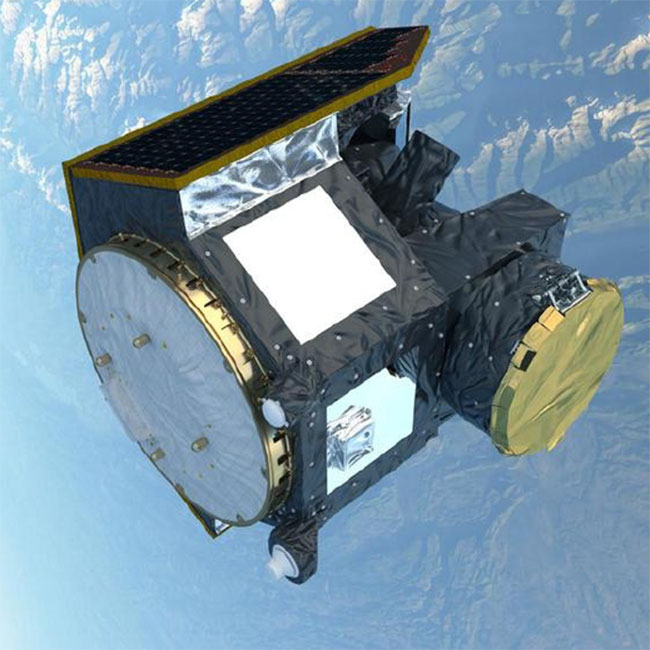
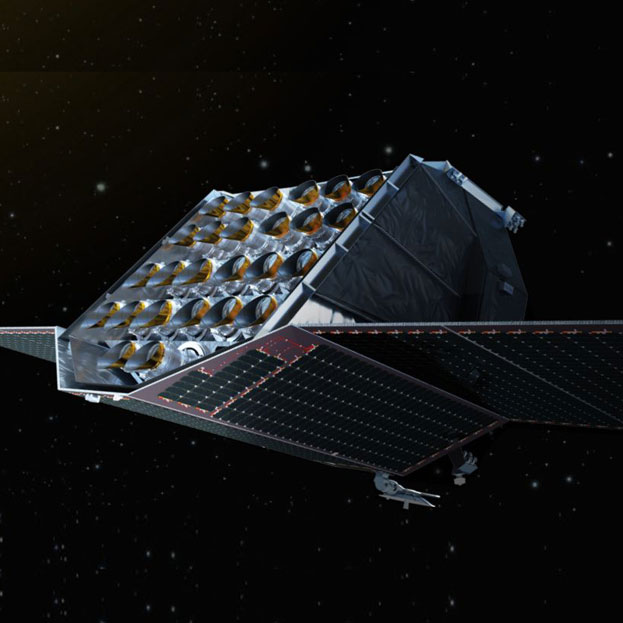
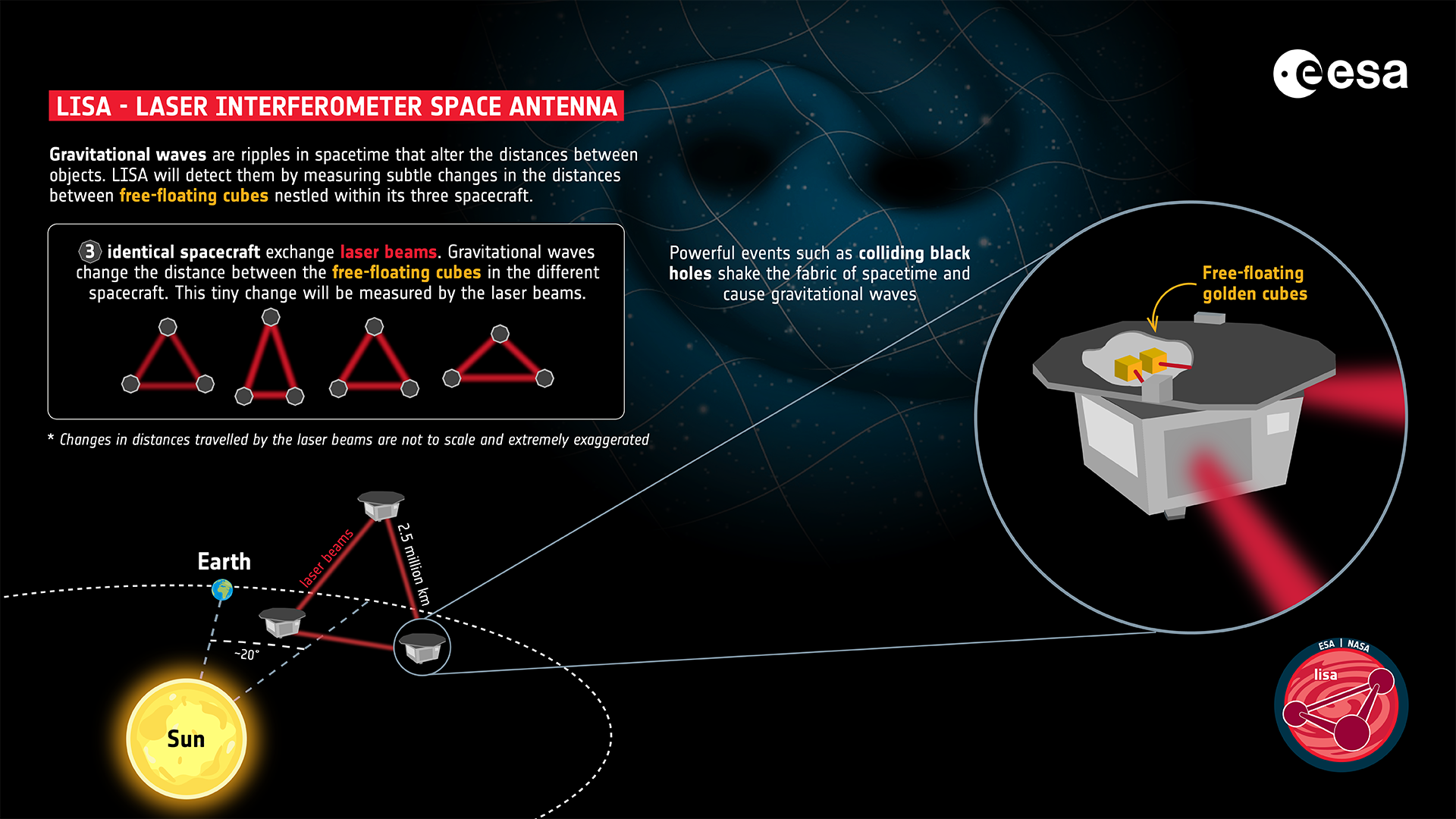
ESA’s Laser Interferometer Space Antenna (LISA) will be the first space-based observatory dedicated to studying gravitational waves: ripples in the fabric of space-time emitted during the most powerful events in the Universe, such as pairs of black holes coming together and merging.
To achieve this feat, LISA is designed to be a constellation of three spacecraft. They will fly in a triangular formation, trailing Earth in its orbit around the Sun. Each side of the equilateral triangle will span 2.5 million km, more than six times the Earth-Moon distance.
Flying a trio of spacecraft over such large distances has never been attempted before. And as if that were not difficult enough, the spacecraft will exchange laser beams with each other over their vast separation.
The launch of the three spacecraft is planned for 2035, on an Ariane 6 rocket.
HST has qualified the critical epoxy bonding process for the instrument’s optical bench population. We optimized this technology to achieve peak performance in mechanical resistance, ultra-stability, and reliability, effectively addressing the mission’s primary design drivers. Building on this achievement, HST is currently integrating precision alignment protocols into the workflow, preparing for the full integration of all LISA Flight Model Optical Benches using our qualified bonding expertise.
 ESA courtesy